What Is Words On A Page

Words On A Page is a blog dedicated to analysing films old and new. We look at the story, the characters, the action, and everything else that defines a film.

We aim to show that the foundation of every film is the script- The "Words On A Page" that give this blog its name. In doing this, we aim to encourage aspiring screenwriters to look at both the strengths and weaknesses of films that they see, and apply the lessons learnt to their own scripts
Showing posts with label Classics. Show all posts

Sunday, 31 August 2014

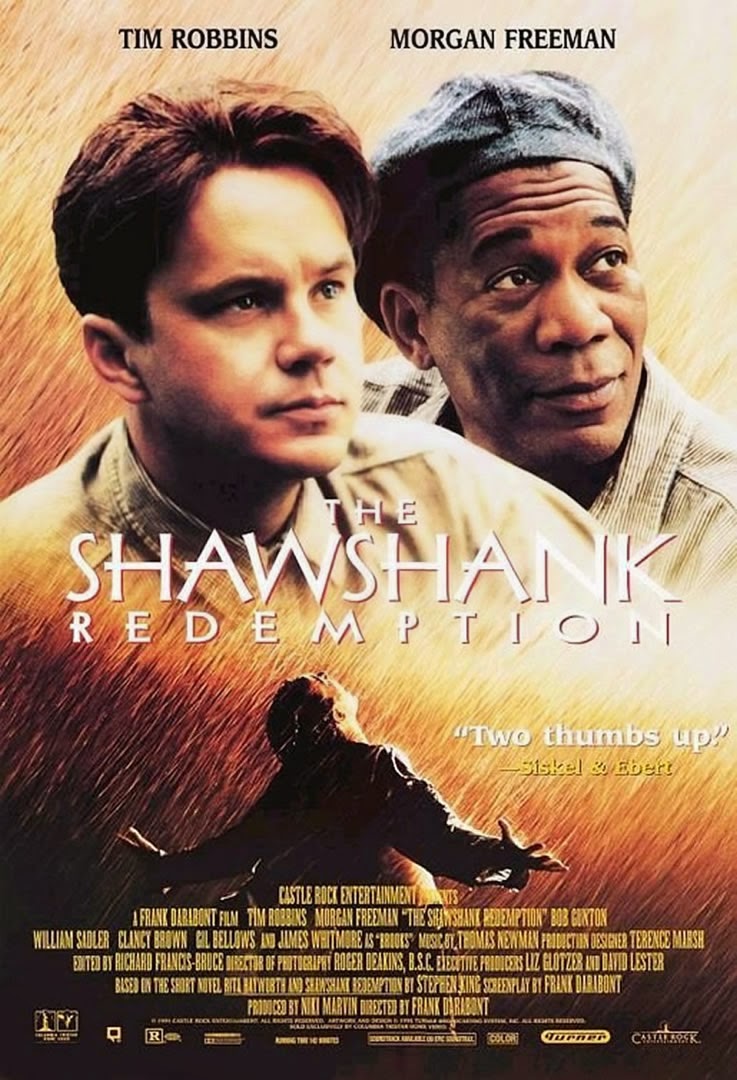
Script to Film – The Shawshank Redemption


It is undoubtedly fascinating to analyse films, but it is just as interesting to look at the screenplays that they were filmed from.  In this feature, we will be looking at how key scenes from a movie are depicted in the original script. Sometimes, the film and script are very similar, but there can also be some substantial differences, especially if the script is an early draft.

For the first “Script to Film” article, we will be looking at The Shawshank Redemption. The script for the film can be accessed below:


Who Wrote It?

The script for The Shawshank Redemption was written by Frank Darabont, who directed the film, and was based on the short story “Rita Haywoth and the Shawshank Redempton” by Stephen King.

How Long Is It?

The Shawshank Redemption is 142 minutes long, including credits.

What’s It About?

The Shawshank Redemption follows Andy Dufresne (Played by Tim Robbins), a banker who is falsely convicted for the murder of his wife and her lover, and sentenced to life without parole in Shawshank Prison.  There, he forms a friendship with fellow prisoner Red (Played by Morgan Freeman). Used as by the corrupt Warden Norton (Played by Bob Gunton) as an assistant to cover up his money laundering, Andy bides his time in prison, never losing hope in the possibility of being free.

Script to Film – The Shawshank Redemption
(The Following May Contain Spoilers)

First Night – The brutality of Shawshank Prison is highlighted in Andy’s first night there, as the long-serving inmates take bets on which of the new prisoners will break down crying. One scene that was in the script but not the film shows various new inmates terrified by their menacing surroundings. Whilst this effectively illustrates how difficult it is adjusting to life in prison, it was felt to be unnecessary. The voices of the various prisoners demonstrate the same effect as they “carry on, sly and creepy in the dark”. This creates an ominous atmosphere, and by showing the prison as a whole instead of focusing on specific inmates, makes the viewer feel like they are inside as well, which emphasises the confined the prisoners at Shawshank are.

The sadistic head guard at Shawshank, Captain Hadley, responds to the breakdown of one anxious, overweight prisoner by viciously beating him, causing his death. In the script, this act of violence is depicted in a manner that emphasises its barbarity and suggests how common it is in the prison; “All we hear now is the dull THWACK, THWACK, THWACK of the baton”. As well as showing the brutality of the act, this monotony also demonstrates detachment, as all the prisoners can do is look on in horrified silence.  The film keeps this disengagement by depicting the scene in extremely low lighting. This emphasises Hadley’s savage nature and sets up the prisoner’s lack of freedom and independence perfectly – any instinct to act against this abuse of power was quashed a long time ago.

Brooks Outside Jail – One of the saddest moments in the film centres on Brooks (Played by James Whitmore), an elderly prisoner who finally gets released after decades in prison. However, he is unable to adapt to life outside, and soon hangs himself. Brook’s disorientation in the outside world is depicted in the script through descriptions, such as a memorable one which depicts his arrival at a halfway house with the words “He just stands there, like a man waiting for a bus”. In the movie, this is shown through close-ups, as the confusion and fear on Brook’s face is expressed perfectly by Whitmore. No matter how good a scene is in the script, it requires a skilled actor to make it work. However, a strong script is essential for encouraging a great performance, and here both elements are present.

The other affecting part of the sequence is Brooks’ narration, as it becomes increasingly clear that the letter that he has just sent is a suicide note. The rapid pace of change in American society – the automobiles that Brooks considered a novelty when he was young are now everywhere – contrasts with the unfading routine of prison life, and Brooks finds himself unable to understand or comprehend it. As Brooks speaks, we find out the extent to which he is lost without the rigidity of the system  that has defined the majority of his life– he is even willing to commit a crime just so he can go back to Shawshank. In this context, the Voice-Over provides insight into Brook’s thoughts and motivations and sets up the ensuring tragedy, allowing it to be even more powerful.

Playing Beethoven – One particularly iconic scene highlights Andy’s commitment to providing hope for himself and his fellow prisoners. In it, he finds the collection of books and records donated to Shawshank by the government. He takes out a Mozart record and plays it, hijacking the prison’s sound system so he can broadcast it to all the prisoners. The power of the record is set up by Andy’s reaction to discovering it. According to the script; “It is a thing of beauty. It is the grail”. This powerful language shows that, in prison, something as mundane as a record of classical music can have a potent effect. 

The effect that the music has is highlighted through a combination of description and dialogue. We see numerous scenes of inmates throughout Shawshank stopping to listen. Throughout the prison, the monotony of daily life has been disrupted by something that is new and unfamiliar to the majority of inmates, and therefore memorable and exciting.   Red’s narration makes the significance of Andy’s rebellious gesture clear to the audience, as he states that whilst the record was on, “Every last man at Shawshank felt free”. The importance of providing hope in a place where hopelessness dominates is one of the central themes of the story, and the use of classical music is an effective way of emphasising this.

Tommy’s Death – Norton crosses the line from being merely corrupt into an outright villain when he orders the murder of Tommy, an inmate who has evidence that could prove Andy’s innocence. The impact of the scene is magnified by the lead-up to the murder, as Norton arranges a secret conversation in the prison car park.  Because we know that Norton does not want the evidence of his corruption to come to light, his show of helpfulness is unnerving, as most of his apparently sincere dialogue (“The right decision. Sometimes it’s hard to figure out what it is, understand?”)  takes on an entirely different meaning that Tommy is entirely unaware of, as he answers Norton’s questions innocently and earnestly. This Scene relies on the audience knowing that something bad will happen, but not being able to figure out exactly what until it is too late. This generates suspense and ensures that they remain interested.

The deed itself is depicted in the script in a vivid and shocking manner that contrasts with the matter-of-fact depictions of violence from earlier in the film. The gunfire is shown in graphic detail “Chew[ing]” Tommy “to pieces” until he falls to the ground in “A twitching, thrashing heap”. This brutality highlights how horrific and senseless the murder is, and reveals just how far Norton will go to prevent the truth surrounding his activities to get out. It makes us root for Andy to break free and expose him, but highlights the fact that he has to do so quickly, thus increasing the tension in preparation for the climax.

The Escape – The Shawshank Redemption’s famous climax depicts Andy’s escape from prison through a tunnel that he slowly created throughout the period he spent incarcerated. The guards’ reaction to this is one of initial confusion, which is conveyed through the sentence “Their faces go slack, stunned”. This alliteration shows the reader that the event that has just occurred is a very significant and shocking one. This bewilderment soon turns into blind panic, as they inspect everything in the room “As if Andy might be hiding in a Kleenex or a tube of toothpaste”. This shows how surprising Andy’s escape is, and leaves us wanting to know how it happened, setting up the final reveal.

Andy’s escape plan is portrayed as a twist. We are not aware of it at the time, but when we find out about it, every detail makes perfect sense. Red highlights this in his narration, likening Andy’s interest in geology to his escape, as the two things most important to both are “Pressure and time”. This reinforces the key themes without seeming too on-the-nose, and makes Andy’s escape even more satisfying.

Verdict

The Shawshank Redemption owes its status as a modern classic to a strong script brought to life by a talented cast and crew. It provides us with a number of feelgood scenes, but also contains several dark and violent ones. This balance of optimism and gritty realism ensures that the film never seems false or preachy, and the happy ending feels earned. The riveting storyline, the creative descriptions and the memorable characters ensure that the script stands out, and Frank Darabont brings it to life without reducing the quality. Therefore, both the script and the film are essential for budding screenwriters.

Friday, 15 August 2014

5 Screenwriting Lessons – Airplane!


Who Wrote it?


Airplane was written by Jim Abrahams, David Zucker and Jerry Zucker. It was loosely based on the 1957 film "Zero Hour", which was written by Hal Bartlett, John C. Champion and Arthur Hailey (Who all went uncredited for Airplane).


How Long is it?


Airplane is 88 minutes long, including end credits.


What’s It About?


Airplane follows Ted Stryker (Played by Robert Hays), an ex-fighter pilot traumatised by an incident which occurred during the war. When he finds out that his ex-girlfriend Elaine (played by Julie Hagerty) is working in the cabin crew for a flight from Los Angeles to Chicago, he impulsively decides to book a seat on the same plane. However, trouble ensures when the passengers and pilots are taken ill with food poisoning. It falls to Ted to land the plane safely, with the help of Elaine, Dr Rumack (Played by Leslie Nielsen), a doctor dealing with the outbreak, an inflatable pilot called Otto, and the men on ground level in the control tower, including supervisor Steve McCroskey (Played by Lloyd Bridges) and Ted’s former commander Rex Kramer (Played by Robert Stack).

5 Screenwriting Lessons – Airplane!(The Following May Contain Spoilers)


Characters are Key to ComedyAirplane is often regarded as a triumph of jokes over characterisation. Ted and Elaine are the sort of stereotypically good heroes often seem in the disaster movies like Zero Hour and Airport which Airplane parodies. However, the funniest jokes in the movie come from the various side characters. Like Ted and Elaine, they are based on stereotypes, but this makes them even funnier. From the Jive-talking grandma to the inappropriately precocious children, to Johnny, McCroskey’s hyperactive assistant, they all exist solely for the purpose of adding more jokes to the movie. However, these jokes are made even more memorable by the characters unique personalities.   

However, even the more serious characters are subject to some memorable running jokes. McCroskey starts out as a stiff and straitlaced character. However, as he follows Ted’s struggle, he begins to turn to his various addictions: Cigarettes, Alcohol, Amphetamines and Glue. When he starts sniffing glue, he goes off the rails, and leaves the film by diving through a window. The contrast between McCroskey’s initial tough nature and the bug-eyed, dishevelled maniac he turns into makes his deterioration even funnier. Much of the comedy in Airplane is based on extreme contrasts, and an authority figure losing their authority in such spectacular fashion is one of the funniest contrasts possible.

Setting Up a Joke Properly makes the Payoff Funnier – Fourth-wall jokes are common in comedies as zany as Airplane, but they are very difficult to pull off. However, Airplane has one particularly funny Meta joke concerning the casting of the famed basketball player Karem Abdul-Jabbar as one of the pilots, Roger Murdock. When a child is invited to see the pilots in the cockpit, he repeatedly asks Murdock if he is actually Abdul-Jabbar. Murdock continually denies it, until the child criticises his performance as a defender, at which point he breaks character and admits his identity. Later, when the food poisoning outbreak takes hold, he is seen wearing his signature goggles, and he has his LA Lakers shorts and socks on.  In this case, the joke works because it was properly set up. The revelation of Murdock’s identity is treated as a surprise, but it fits the anything-goes sensibility of the film perfectly.

Also on the plane is a seriously ill girl being flown to Chicago so she can receive a heart transplant. One of the air stewards decides to make her feel better by singing to her, so she gets a guitar from a nun and takes it to the patient. However, on the way, she accidently hits the head of various passengers with the guitar. This conditions us to expect an even greater mishap when she actually performs, and we get one – she accidentally knocks the girl's IV Line out and continues singing, unaware of the distress she’s causing, as the rest of the passengers sing along with her. The joke is hilarious because of the oblivious innocence with which she and her fellow passengers ignore the rapidly deteriorating condition of the girl. However, it would not have been as funny if were not aware of the stewardess’ short-sightedness from the beginning.

Never Forget the Rule of Three – The “rule of three” is often used in Airplane, referring to running jokes that are used exactly three times. The first time is set-up, the second reinforces the picture, and the third use is the punchline – subverting the routine for comedic effect. One running joke from the movie which relies on the rule of three concerns two passengers who communicate in “Jive talk”, which is translated for the viewer with subtitles. We see them communicate in Jive twice, and it’s funny on both occasions. On the third occasion, when one of the passengers is taken ill, the stewardess looks for someone who can speak Jive and translate for him. An old woman steps up to do the task, but soon she begins arguing with the “Jive Dudes”. The fact that she is even more proficient at the language than they are subverts the clichéd depiction of an old lady (Through the tough-talking Granny has become a stereotype in itself) and makes fun of the idea that Jive is a strange and exclusive language.

Another memorable running joke concerns the character of Dr. Rumack. As Ted prepares to land the plane, Rumack tells him “Good luck.  We're all counting on you”, and repeats the phrase during the landing. When Ted lands safely, Rumack enters the cabin and says the same thing a third time, completely oblivious to the fact that the danger has passed. This is funny because of the incongruity between the serious context when the line was used the first two times, and the peaceful state on the third occasion. The change in situation transforms the line from a clichéd piece of disaster movie dialogue into another very funny quote.

Don’t Forget the Little Details – Airplane primarily parodies the disaster movie Zero Hour, and is so blatant in its mimicry that the writers had to get the rights to remake Zero Hour so that they wouldn't run the risk of being sued for plagiarism. Two of Airplane’s most memorable running jokes were extensions of scenes and lines from Zero Hour. A line in which the Air Traffic supervisor says “Looks like I picked the wrong week to quit smoking” turns into the iconic sequence depicting McCroskey relapsing into his various addictions. The innocent nature of a sequence where a kid gets invited into the cockpit and talks to the pilots is memorably subverted, as Captain Oveur’s questions to the child become increasingly inappropriate. In both cases, throwaway moments from the original film are transformed into creative and funny sequences that give us a number of brilliant jokes and quotes.

The film’s tone is established with a simple but funny opening. The distinctive theme tune from the iconic movie Jaws sounds, as a plane’s tailfin cuts through the skies like a shark’s fin cutting through water. This is soon followed by a memorable running gag that occurs in the background, as two announcer’s state the same message simultaneously. However, they soon begin to get mixed up and give differing messages, leading to an argument between the two which reveals a personal relationship. These two jokes show that the comedy is wacky, easy to understand, and everywhere in the movie.

Remember to Take Some Things Seriously – One reason for Airplane’s success was the fact that the characters (With the exception of Johnny) take the ludicrous events that occur during the film entirely seriously. This is made particularly clear in a sequence at the end, where Kramer’s congratulatory message to Ted turns into a monologue that continues long after everyone has left the plane. It is delivered in a very serious manner by a very serious character, and he is unaware of how long-winded and silly it is, which maximises the level of humour.

Another aspect of the film that is funny because it is played (Relatively) straight is Ted’s backstory. Whilst his flashback sequences are as full of jokes as the rest of the movie, Ted’s main motivation is to get over his guilt regarding an accident in the war that claimed the lives of seven men. With the melodramatic music and voice overs, it resembles the typical hero’s journey in a disaster movie. However, it chooses to play typically dramatic moments for comedy which only the viewer is aware of. Ted’s memories of the ill-fated flight in the war are depicted through stock footage, and this is taken to its logical extreme, as the footage goes back in time to show us bizarre planes from the early days of Aviation. Whilst the viewer is aware of how artificial Ted’s central conflict is, he is not, and this makes the parody seem more sincere, and therefore funnier.

Verdict


Although parody films have gained a bad reputation in recent years, Airplane still retains its status as one of the funniest and most quotable movies of all time. It plays on the earnest and melodramatic nature of disaster movies, and provides a number of zany jokes that demonstrate how well the writers understand the basic tenets of comedy. There is a wide range of jokes, from verbal to slapstick, they are set up well and delivered effectively, and the characters are all memorable. Whilst many jokes are dated now, a significant portion are just as funny as they were when the film was released. In a movie estimated to contain about 250 jokes, that is a major accomplishment.

Thursday, 31 July 2014

5 Screenwriting Lessons- Dr Strangelove, Or: How I Learned To Stop Worrying and Love the Bomb


Who Wrote It?
Director Stanley Kubrick wrote the script with Terry Southern and Peter George. Peter George was also the writer of “Fail Safe”, the book upon which Dr Strangelove was loosely based.

How Long is it?
Dr Strangelove is 102 minutes long, including credits.

What’s it About?
Dr Strangelove chronicles a nuclear crisis triggered by the deranged General Jack D Ripper (Played by Sterling Hayden). When Ripper orders the B-52 bombers under his command to attack Russia, the most powerful men in America gather in the “War Room” to try and sort out the ensuing crisis. They include the US President, Merkin Muffley (Played by Peter Sellers), General Buck Turgidson (Played by George C. Scott) and the wheelchair-bound ex-Nazi Dr Strangelove (Also played by Peter Sellers). Meanwhile, Ripper’s executive officer Captain Mandrake (Peter Sellers again, in his third role in the film) tries to find a way of recalling the planes, but the crew of one bomber, captained by Major “King” Kong (played by Slim Pickens) tries to carry out its mission, regardless of the obstacles or consequences.

5 Screenwriting Lessons from Dr Strangelove, or: How I Learned to Stop Worrying and Love the Bomb
(The Following May Contain Spoilers)

Sometimes, The Audience Should be made to Feel Smarter than the Main Characters- Satirical films like Dr Strangelove rely on a (mostly) foolish set of characters to highlight their points about the flaws in our institutions. General Ripper claims that “War is too important to be left to the politicians” as they are no good at strategic thought. However, he is sending dozens of men to bomb the USSR based on a conspiracy theory that only he believes. This shows that, instead of encouraging peace, leaving war in the hands of individuals like Ripper increases the destruction caused by the conflict.

Ripper’s motive for ordering the planes to attack the Soviet Union is his belief that the fluoridation of water is part of a Communist plot “to sap and impurity all of our basic bodily fluids”. Ripper claims that he became aware of it when he experienced “A profound sense of fatigue” and “A feeling of emptiness” after having sex with a woman. The fact that Ripper takes this entirely normal sensation as proof of a communist conspiracy highlights just how distrusting he is, and just how unqualified he is to be in charge of the US military.

Incongruity Should be Everywhere Incongruity is a key part of Dr. Strangelove. Many of the small lines and details are full of irony and subversion. Apart from the famous line “You can’t fight in here. This is the War Room!” delivered by President Muffley towards General Turgidson and the Russian Ambassador in attendance at the crisis talks, there are a number of small details and sight gags in the scene in which troops invade General Ripper’s base. Two of the signs there read “Keep off the Grass” and “Peace is Our Profession”. The orderly and formal nature of the base creates a contrast with, and therefore emphasises, the chaos unfolding inside.

Another example of incongruity highlighting the bizarre nature of the central crisis is when the nature of the Soviet Doomsday Machine is revealed. Dr Strangelove dismisses the idea that there is one currently in operation, claiming that “The whole point of the Doomsday Machine…Is lost if you keep it a secret”. However, the Soviet Ambassador confirms its existence, claiming that it would have been revealed to the world later. Keeping such a powerful deterrent secret contradicts the very purpose of having it, and demonstrates how ridiculous the posturing on both sides is.

Exaggeration Leads to Effective Satire - If you have ever used a payphone, you will be able to appreciate how inconvenient it is to be short on money. In Dr Strangelove, this is taken a step further. When General Mandrake is in that situation, he is trying to call President Muffley and tell him that he’s figured out the coded message which will make the US bombers turn back. This serves the purpose of showing how chaotic and inefficient the communication between the government and the army is, as the safety of the world ends up depending on the presence of change in a Coca-Cola Machine. By taking a trivial but relatable scenario and placing it in the middle of such an important situation, the sequence makes viewers aware of how difficult it is to solve an international crisis, especially with the threat of nuclear annihilation looming over the horizon.

Another instance in which a critical event is exaggerated in the name of satirical humour is the famous scene of Kong “Riding the bomb”, which is one of the funniest and most iconic moments in the film. The humour comes from the incongruity between the effects of the action and the way Kong treats it. When the bomb lands, it will not only obliterate him, but set off the chain of events which will render the earth uninhabitable. However, Kong is waving his hat and cheering as if he was riding a bull at a rodeo. The pleasure he takes in unleashing the bomb is a little bit unnerving, but it is so over-the-top that you cannot help but laugh.

Subvert the Established Standards - In the midst of a crisis that could spell the end of the world, you would normally expect a telephone conversation between the US President and the Soviet Premier to be formal and serious, with both sides trying to discuss the matter in a loud and aggressive manner. However, in Dr Strangelove, President Muffley’s attempts at informing his Russian counterpoint of the impending crisis represent a great example of awkward humour. Muffley begins his conversation with banal small talk (“It’s good to be fine”), then tries to explain General Ripper’s actions by claiming that “He went and did a silly thing”. By depicting the impending bombing in this way, he unintentionally makes it seem trivial and ridiculous. The understatement in this scene creates brilliant comedy, and also highlights that Muffley is out of his depth handling the crisis – a stark contrast to the prevalent image of the strong, decisive president bravely handling international disputes that became popular after Kennedy managed to diffuse the Cuban Missile Crisis (which happened whilst the film was being written).

This is not the only time that the film undermines the conventional belief that the USA is being looked after by brave and heroic people. The opening of the movie is shot and narrated like a war movie or Newsreel, invoking audience memories of the usually positive depiction of the US air force in those mediums. However, when we first see Major Kong, the government manual he appears to be reading turns out to be an issue of Playboy. This is a quick and amusing way of establishing that, in contrast to the honourable soldiers of more traditional war movies, Kong and his crew are a distinctly unheroic and ordinary lot.

Deliver the Message Effectively – Dr Strangelove aims to expose the flaws in the US government’s handling of the Cold War, which was a major concern when the movie was released in 1964. The prevalent belief in USA at the time was that neither they nor the Soviet Union would dare attack each other, because it would lead to both sides being wiped out. This idea of Mutually Assured Destruction is taken to its logical conclusion with the Soviet’s Doomsday Machine, and all it takes to set it off is a single bomber whose crew were unable to take orders telling them to go back. This highlights how fragile the peace between USA and the USSR was, and encourages viewers to consider the potential costs should the conflict escalate.

The consequences of the distrust between the two sides is highlighted at the end, as the US government considers Strangelove’s proposal for a select band of civilians to live underground for about 100 years until the radiation generated by the Doomsday machine has subsided. However, Turgidson opposes the proposal, claiming that the nuclear apocalypse will not prevent the Soviets from trying to take over their mineshafts. He is so scared of the Communists that he believes that war will continue, even when almost everyone on both sides has been destroyed. This proves how ridiculous the USA’s hatred of their enemies can be, as it continues even after its consequences have rendered the world uninhabitable.

Verdict

50 years after its initial release, Dr Strangelove still holds up as a classic satire. It’s a bit slow at times, owing to the large amount of technical terms used in the discussions of the conflict, but it is certainly worth watching in full. It is full of irony, exaggeration, subversion, stupidity (from the characters) and intelligence (from the writers), the five defining features of satire. Most importantly, it communicates its messages about the folly of the cold war effectively, with great lines, great scenes and memorable characters.