What Is Words On A Page

Words On A Page is a blog dedicated to analysing films old and new. We look at the story, the characters, the action, and everything else that defines a film.

We aim to show that the foundation of every film is the script- The "Words On A Page" that give this blog its name. In doing this, we aim to encourage aspiring screenwriters to look at both the strengths and weaknesses of films that they see, and apply the lessons learnt to their own scripts
Showing posts with label Key Scenes. Show all posts

Tuesday, 16 September 2014

Script To Film - Jurassic Park


The screenplay for Jurassic Park can be found below:


It is a first draft, and is therefore substantially different from the finished film, bearing a greater resemblance to the source material. The changes made between the script and the finished film form the basis of this post.

Who Wrote It?

The film was written by Michael Crichton and David Koepp, and based on the novel by Michael Crichton.

Who Directed It?

Jurassic Park was directed by Steven Spielberg.

How Long Is It?

The film is 121 minutes long, including end credits.

What’s It About?

The eccentric tycoon John Hammond (Played by Richard Attenborough) invites a pair of scientists, Dr Alan Grant (Played by Sam Neil) and Dr Ellie Sattler (Played by Laura Dern), to visit and endorse his pet project: Jurassic Park. Based on a tropical island, it contains dinosaurs of all kinds, brought to life through advanced cloning technology.  Other guests on the trip include rebellious mathematician Ian Malcom (Played by Jeff Goldblum) and Hammond’s two grandchildren, Tim and Lex (played by Joseph Mazello and Ariana Richards). However, when an employee tries to steal the park’s advanced technology, he inadvertently releases the dinosaurs, who begin to run amok. As Hammond, Ellie and Malcom try to find a way to contain the creatures, Grant, Tim and Lex journey across the island to find the rest of the group.

5 Key Scenes – Jurassic Park
(The Following May Contain Spoilers)

Discussions With Hammond – In the film, most of the opposition to the idea of resurrecting dinosaurs is voiced by Ian Malcom in a speech during a dinner meeting. He notes that Hammond and his scientists were “so preoccupied with whether they could, that they didn’t stop to think about whether they should”. This sequence serves two purposes. Most importantly, it prepares us for the fact that the dinosaurs will go on the rampage. It also sets up the tension between Hammond and Malcom, indicating that the two will be forced to put their animosity aside when the dinosaurs attack.

On the other hand, the script omits Malcom completely, and cuts the dinner scene. Instead, the objections to Jurassic Park are primarily voiced by Ellie, who claims that dinosaurs cannot repress their hunter instincts, and Grant, who notes that commercialising science leads to “A disregard for method” that eventually leads to the failure of the island. However, because the screenplay is focused on action, there is less emphasis on the issues regarding the cloning of dinosaurs. As a result, the characters are less developed, as their views on the matter go a long way towards defining their personalities.

T-Rex Attack – The most iconic action sequence in Jurassic Park is the Tyrannosaurus Rex attack that occurs at the halfway point of the film. At the start of this scene, the T-Rex’s arrival is signalled by a vibrating glass of water. In the script, it is signalled in a more conventional manner, as “The whole car vibrates” to signal the arrival of the dinosaur. The vibrating glass of water is more effective, as it increases the suspense. As soon as the protagonists notice what is happening to this minor object, the slow-building sense of awareness is more terrifying then the sudden attack in the original script.

This leads to the first major chase in the movie, as the T-Rex attacks the car containing Tim and Lex. The script portrays the creature as toying with the cruiser “like a dog with its bone”. This description highlights its destructive nature, as the car, and the children inside, are treated by it as a plaything. The film stays true to this description, and depicts the dinosaur in close-up from Tim and Lex’s perspective. This makes the creature even more dangerous, because it causes large amounts of damage with little effort.

Grant And The Kids - Dr. Grant is the story's central protagonist, as he has the strongest character arc out of all the main characters. At the beginning, he is opposed to the idea of having children, but looking after Tim and Lex brings out the father in him. This is highlighted in a sequence where they have to climb over a perimeter fence before the power gets turned on. It appears in both the film and the script, and there are a number of similarities between the two depictions, most notably the fact that one of the children (Lex in the script, Tim in the film) is afraid of heights. However, the risk level in the screenplay turns out to be low – the power doesn’t return. The fact that the obstacle isn’t as severe as it is in the film reduces the pressure placed on Dr Grant, and therefore ensures that the episode has less of an impact on him and his relationship with Tim and Lex.

One notable scene in the movie depicts the three hiding in a tree for the night. They crack a number of jokes about dinosaurs, and Grant promises to watch for dinosaurs and protect the children. However, in the original script, the children fall asleep the instant they settle down in the tree- there are no heart-warming interactions between them and Grant. Overall, the idea of Grant being a father figure is far less prominent in the script then it is in the film.

The Final Battle – The climax of Jurassic Park depicts the protagonists taking on Velociraptors who are attacking the Island headquarters. This sequence is divided into two parts. During the first part, Tim and Lex are chased through the kitchen by two Velociraptors. In the script, they use steaks to trick the raptors into entering a walk-in freezer. In the film they also use trickery; Lex hides in an oven, and the dinosaurs mistakenly attack her reflection. However, the two children seem a bit calmer and more composed in the script. Their panic in the finished sequence increases the tension, as it emphasises the fact that they are a disadvantage and leaves the viewer wondering how they will be able to survive.

In the second part of the climax, Grant, Ellie and the children face the Velociraptors in the Visitor Centre, dangling from the giant Tyrannosaurus skeleton that is the main exhibit there. In the film, the Velociraptors are defeated by the timely arrival of a T-Rex. This represents a “payoff” following the Tyrannosaurs’ appearance in the middle of the film, because a monster that memorable should not be used for a single scene only. However, the live T-Rex does not appear in the screenplay. Instead, the raptors are defeated by Grant single-handedly, as he uses the skeleton to crush them. Whilst this cements Grant’s growth into a strong, brave hero, it seems like an easy way of defeating the implacable velociraptors. Therefore, the denouement of the film proves to be more memorable.

Hammond’s Behaviour – The screenplay retains the novel’s depiction of Hammond as an antagonist who is more concerned with making money from the theme park then he is with thinking through the risks and implications of his grand idea.  He responds to Dr. Grant’s criticism with a megalomaniacal rant in which he announces that he will persevere with his idea, and dismisses Grant as “one more negative voice in a universe of negativity”. However, the film makes him into a more likeable character. At the end, he decide to leave the island with the rest of the protagonists (albeit with a degree of reluctance) and responds to Dr Grant’s comment that he has decided not to endorse the park with a simple “So have I”. Character arcs are a convenient way to distinguish between protagonists and antagonists, and by realising that his dream cannot be maintained, the version of Hammond we see in the film is able to grow as a character and therefore remain sympathetic.

This difference in personality between is summed up with how the character is introduced in both versions. In the film, he is introduced turning up suddenly at Grant and Ellie’s dig.  His primary motive for turning up at the location incognito is for the sense of adventure. This establishes Hammond’s energetic personality, but also shows that he is overconfident, as he nonchalantly helps himself to champagne from the fridge. Conversely, in the script, he is not introduced until the protagonists arrive on the island. This makes him into a more mysterious figure with a greater sense of power, and establishes how dependant he is on his park. In the screenplay, Hammond’s fanatical obsession with making the park successful ensures that he will be blind to the flaws in his idea, making him unable to change and ensuring that he poses an obstacle to the protagonists.

Verdict

Jurassic Park improved substantially between the first draft and the finished film. Whilst the original script has a number of strong action sequences, the finished film contains more likeable and better-developed characters, and also provides a fuller focus on the issues arising from cloning. Furthermore, it benefits immeasurably from Steven Spielberg’s direction, as he wrings the maximum levels of tension out of the various action sequences, increasing the jeopardy levels through his focus on the small details, which are expressed through close-ups. He also manages to give the various dinosaurs, who are the story’s most spectacular and important aspect, plenty of memorable moments, which allow them to stand out as characters in their own right. As a result of the changes made to the screenplay, Jurassic Park is an example of a summer blockbuster that can be enjoyed for both the spectacle and the characters.

Sunday, 31 August 2014

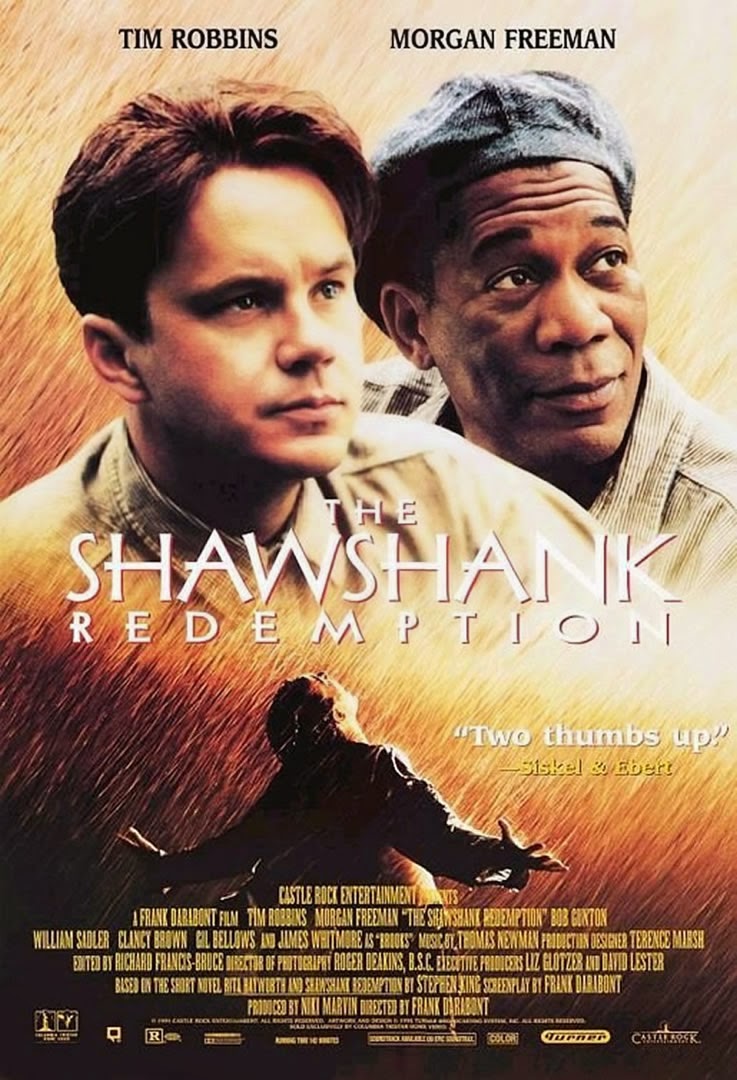
Script to Film – The Shawshank Redemption


It is undoubtedly fascinating to analyse films, but it is just as interesting to look at the screenplays that they were filmed from.  In this feature, we will be looking at how key scenes from a movie are depicted in the original script. Sometimes, the film and script are very similar, but there can also be some substantial differences, especially if the script is an early draft.

For the first “Script to Film” article, we will be looking at The Shawshank Redemption. The script for the film can be accessed below:


Who Wrote It?

The script for The Shawshank Redemption was written by Frank Darabont, who directed the film, and was based on the short story “Rita Haywoth and the Shawshank Redempton” by Stephen King.

How Long Is It?

The Shawshank Redemption is 142 minutes long, including credits.

What’s It About?

The Shawshank Redemption follows Andy Dufresne (Played by Tim Robbins), a banker who is falsely convicted for the murder of his wife and her lover, and sentenced to life without parole in Shawshank Prison.  There, he forms a friendship with fellow prisoner Red (Played by Morgan Freeman). Used as by the corrupt Warden Norton (Played by Bob Gunton) as an assistant to cover up his money laundering, Andy bides his time in prison, never losing hope in the possibility of being free.

Script to Film – The Shawshank Redemption
(The Following May Contain Spoilers)

First Night – The brutality of Shawshank Prison is highlighted in Andy’s first night there, as the long-serving inmates take bets on which of the new prisoners will break down crying. One scene that was in the script but not the film shows various new inmates terrified by their menacing surroundings. Whilst this effectively illustrates how difficult it is adjusting to life in prison, it was felt to be unnecessary. The voices of the various prisoners demonstrate the same effect as they “carry on, sly and creepy in the dark”. This creates an ominous atmosphere, and by showing the prison as a whole instead of focusing on specific inmates, makes the viewer feel like they are inside as well, which emphasises the confined the prisoners at Shawshank are.

The sadistic head guard at Shawshank, Captain Hadley, responds to the breakdown of one anxious, overweight prisoner by viciously beating him, causing his death. In the script, this act of violence is depicted in a manner that emphasises its barbarity and suggests how common it is in the prison; “All we hear now is the dull THWACK, THWACK, THWACK of the baton”. As well as showing the brutality of the act, this monotony also demonstrates detachment, as all the prisoners can do is look on in horrified silence.  The film keeps this disengagement by depicting the scene in extremely low lighting. This emphasises Hadley’s savage nature and sets up the prisoner’s lack of freedom and independence perfectly – any instinct to act against this abuse of power was quashed a long time ago.

Brooks Outside Jail – One of the saddest moments in the film centres on Brooks (Played by James Whitmore), an elderly prisoner who finally gets released after decades in prison. However, he is unable to adapt to life outside, and soon hangs himself. Brook’s disorientation in the outside world is depicted in the script through descriptions, such as a memorable one which depicts his arrival at a halfway house with the words “He just stands there, like a man waiting for a bus”. In the movie, this is shown through close-ups, as the confusion and fear on Brook’s face is expressed perfectly by Whitmore. No matter how good a scene is in the script, it requires a skilled actor to make it work. However, a strong script is essential for encouraging a great performance, and here both elements are present.

The other affecting part of the sequence is Brooks’ narration, as it becomes increasingly clear that the letter that he has just sent is a suicide note. The rapid pace of change in American society – the automobiles that Brooks considered a novelty when he was young are now everywhere – contrasts with the unfading routine of prison life, and Brooks finds himself unable to understand or comprehend it. As Brooks speaks, we find out the extent to which he is lost without the rigidity of the system  that has defined the majority of his life– he is even willing to commit a crime just so he can go back to Shawshank. In this context, the Voice-Over provides insight into Brook’s thoughts and motivations and sets up the ensuring tragedy, allowing it to be even more powerful.

Playing Beethoven – One particularly iconic scene highlights Andy’s commitment to providing hope for himself and his fellow prisoners. In it, he finds the collection of books and records donated to Shawshank by the government. He takes out a Mozart record and plays it, hijacking the prison’s sound system so he can broadcast it to all the prisoners. The power of the record is set up by Andy’s reaction to discovering it. According to the script; “It is a thing of beauty. It is the grail”. This powerful language shows that, in prison, something as mundane as a record of classical music can have a potent effect. 

The effect that the music has is highlighted through a combination of description and dialogue. We see numerous scenes of inmates throughout Shawshank stopping to listen. Throughout the prison, the monotony of daily life has been disrupted by something that is new and unfamiliar to the majority of inmates, and therefore memorable and exciting.   Red’s narration makes the significance of Andy’s rebellious gesture clear to the audience, as he states that whilst the record was on, “Every last man at Shawshank felt free”. The importance of providing hope in a place where hopelessness dominates is one of the central themes of the story, and the use of classical music is an effective way of emphasising this.

Tommy’s Death – Norton crosses the line from being merely corrupt into an outright villain when he orders the murder of Tommy, an inmate who has evidence that could prove Andy’s innocence. The impact of the scene is magnified by the lead-up to the murder, as Norton arranges a secret conversation in the prison car park.  Because we know that Norton does not want the evidence of his corruption to come to light, his show of helpfulness is unnerving, as most of his apparently sincere dialogue (“The right decision. Sometimes it’s hard to figure out what it is, understand?”)  takes on an entirely different meaning that Tommy is entirely unaware of, as he answers Norton’s questions innocently and earnestly. This Scene relies on the audience knowing that something bad will happen, but not being able to figure out exactly what until it is too late. This generates suspense and ensures that they remain interested.

The deed itself is depicted in the script in a vivid and shocking manner that contrasts with the matter-of-fact depictions of violence from earlier in the film. The gunfire is shown in graphic detail “Chew[ing]” Tommy “to pieces” until he falls to the ground in “A twitching, thrashing heap”. This brutality highlights how horrific and senseless the murder is, and reveals just how far Norton will go to prevent the truth surrounding his activities to get out. It makes us root for Andy to break free and expose him, but highlights the fact that he has to do so quickly, thus increasing the tension in preparation for the climax.

The Escape – The Shawshank Redemption’s famous climax depicts Andy’s escape from prison through a tunnel that he slowly created throughout the period he spent incarcerated. The guards’ reaction to this is one of initial confusion, which is conveyed through the sentence “Their faces go slack, stunned”. This alliteration shows the reader that the event that has just occurred is a very significant and shocking one. This bewilderment soon turns into blind panic, as they inspect everything in the room “As if Andy might be hiding in a Kleenex or a tube of toothpaste”. This shows how surprising Andy’s escape is, and leaves us wanting to know how it happened, setting up the final reveal.

Andy’s escape plan is portrayed as a twist. We are not aware of it at the time, but when we find out about it, every detail makes perfect sense. Red highlights this in his narration, likening Andy’s interest in geology to his escape, as the two things most important to both are “Pressure and time”. This reinforces the key themes without seeming too on-the-nose, and makes Andy’s escape even more satisfying.

Verdict

The Shawshank Redemption owes its status as a modern classic to a strong script brought to life by a talented cast and crew. It provides us with a number of feelgood scenes, but also contains several dark and violent ones. This balance of optimism and gritty realism ensures that the film never seems false or preachy, and the happy ending feels earned. The riveting storyline, the creative descriptions and the memorable characters ensure that the script stands out, and Frank Darabont brings it to life without reducing the quality. Therefore, both the script and the film are essential for budding screenwriters.