What Is Words On A Page

Words On A Page is a blog dedicated to analysing films old and new. We look at the story, the characters, the action, and everything else that defines a film.

We aim to show that the foundation of every film is the script- The "Words On A Page" that give this blog its name. In doing this, we aim to encourage aspiring screenwriters to look at both the strengths and weaknesses of films that they see, and apply the lessons learnt to their own scripts

Sunday, 12 October 2014

5 Screenwriting Lessons – Collateral


Who Wrote It?

Collateral was written by Stuart Beattie.

How Long is It?

Collateral is 120 minutes long, including credits.

What’s it About?

Collateral follows Max (played by Jamie Foxx), a cab driver in Los Angeles who has been working for years looking for a way to start his own business. His next guest is a mysterious man called Vincent (Played by Tom Cruise), who offers Max $600 to transport him to various LA locations over the course of a single night. Max accepts the offer, but finds out that Vincent is really a hitman contracted to murder five targets during the journey. Forced to continue anyway, Max struggles to find a way to escape as the night progresses.

5 Screenwriting Lessons – Collateral
(The Following May Contain Spoilers)

The Stakes Should Steadily Escalate – As Vincent carries out his five hits, Max is forced to become increasingly involved in his crimes as he tries to prevent them. However, at the start of the story, he is completely passive. The first hit happens in an abrupt and terrifying manner, as the corpse of the victim drops onto the taxi from a nearby window. Max panics when he sees this, shouting and swearing repeatedly, but when Vincent reveals that he was responsible, he does so with a nonchalant “Good guess”, that shows that his actions have not had any effect on him at all, proving that they are almost routine. This establishes Max’s status as a victim, as Vincent’s calm demeanour and his willingness to threaten others and commit violence to achieve his goals place him in complete control of the situation.  The only way that Max can escape from Vincent is if he manages to regain control, and this dynamic allows for increasing tension as the night progresses and his enemy gets closer to his goal.

Switches In Mood Are Important – Sometimes, an elaborate set-up can be used to increase suspense. A notable example of this is in the scene where Vincent carries out his third hit. Stopping at a Jazz bar, he invites the owner to join him and Max at the table and talk about why that genre of music means so much to him. However, when Vincent reveals why he is at the establishment, the scene turns dark abruptly, and the owner is forced to correctly answer a question about the iconic jazz musician Miles Davis, to save his own life. Hearing the owner discuss his backstory makes him into a more sympathetic character, and therefore the viewer wants to see him survive. The fact that Vincent kills him anyway him even more menacing, and highlights the fact that Max lacks the ability to face up to him properly.

Another tense sequence depicts Vincent entering a club to carry out his fourth hit, as a group of cops investigating the case try to execute a stakeout. The sequence is set to loud and up-tempo music and flashing lights. As Vincent tries to get through the crowd to his target and a disorientated Max attempts to escape, the noisy and energetic atmosphere becomes a major distraction. The contrast with the quiet and lonely nature of the majority of settings in the movie, such as Max’s cab, ensures that the club stands out, and its busy nature makes it harder for the characters to fulfil their objectives.

Both Heroes and Villains should be Complex – After he carries out his third hit, Vincent forces Max to stick to his night-time routine by visiting his mother Ida in hospital. However, in the hospital, he behaves with unexpected friendliness and warmth, persuading Max to buy flowers, and striking up a conversation with Ida. The sequence serves two purposes. First of all, it highlights Max’s central flaw, as Ida tells Vincent that “You’d have to hold a gun to his head to make him do anything”. It also makes Vincent seem more human, as he reacts to Ida’s questions with a polite awkwardness that appears genuine, even though he is faking his affection. This makes him even more unnerving, as it ensures it is hard to tell whether or not his statements can be trusted, making him even more difficult to understand.

Meanwhile, Max is defined by his major flaw – an inability to act. Whilst this is common to thriller protagonists, who are expected to start out as passive characters, Max has been spending twelve years waiting for an opportunity to seize his dream. After Vincent kills a policeman who had believed his innocence, Max calls him out on his sociopathic nature. Vincent responds by attacking Max’s cowardice, claiming that his big plans are never going to come to fruition, because he lacks the conviction to make them happen. This turns into an important scene in Max’s character growth, as he defies Vincent, deliberately crashing the cab to ensure that he cannot get to his fifth and final victim. The fact that Max initially lacks commitment means that when he chooses to act, his heroism has a far greater impact then it would if he was active from the beginning.

Make the Extra Characters Significant – The set-up of the movie depicts Max’s interaction with Annie, a friendly lawyer, as she takes his cab to reach her office. In addition to foreshadowing the climax of the movie, where Max has to take action to protect her from Vincent, it allows him to develop as a character and gain our interest. We find out about his dreams of starting a limousine company, and his kindly nature is highlighted when he allows Annie to keep his favourite photograph. Annie is also a well-rounded individual, as she listens sympathetically to Max, and tells him about the various problems she faces when working on her cases. This ensures that the audience wants the two to start a relationship, creating a reason for them to continue watching in the hope that they escape and get their happy ending.

Another character who manages to be memorable in spite of a lack of screen time is Felix, the mobster who has hired Vincent to carry out his various assassinations. Max meets him when he is forced by Vincent to assume his identity and find the information on the last two victims. Felix provides this exposition in the form of a monologue in which he compares himself to Santa Claus and Vincent to Black Peter, a figure who punishes naughty children.  This analogy is both childish and threatening, but manages to convey the key points effectively – Vincent’s targets represent a threat to Felix, and he is being hired to “punish” them. With his offbeat yet menacing personality and a brief mention of his family that serves to humanise him, Felix stands out as a unique and interesting character, and his delivery of the key information is highly intriguing. As a result, the information that Max and the audience need to know stands out, because it is being given in a manner that makes it worth hearing.

Make the Action Sequences Exciting – Because it focuses on characters and atmosphere in a bid to generate suspense, Collateral uses action sequences sparingly. However, when they do occur, they are intense in nature. Most of the violent scenes in the movie are due to the actions of Vincent, who casually carries out his various kills with a high level of brutality. Just after performing his second hit, Vincent returns to find that a pair of muggers have stolen his briefcase from Max. He follows them and shoots them both. Once he has retrieved the item, he notices one of the men writing in pain, and shoots again to finish him off. As well as setting up how important the briefcase is to Vincent, it shows that he reacts to setbacks with a cold efficiency, as the severity of his retaliation is unnecessary, even given the obnoxious nature of the victims and the potential repercussions of their theft. In a very brief and one-sided burst of action, the extent of the threat which Vincent poses to Max is made disturbingly clear.

After the slow-building tension of the first two acts, Collateral climaxes with an elaborate chase sequence, as Max tries to rescue Annie from Vincent. As Vincent cuts the electricity at Annie’s office, the darkness increases the tension of the scene, as it makes it harder for Annie to get out, and places her at a disadvantage. Meanwhile, Vincent uses mirrors to track his target, and this allows him to move without her knowing where he is and what he is doing. Vincent’s increased freedom in this confined space forces Max to react quickly if he wants to save Annie. In chase scenes, the villain should usually have an ability that makes it harder for the heroes to defeat them, and Vincent’s experience and composure make him a formidable opponent.

Conclusion

Collateral is a textbook example of how to make an efficient and engrossing thriller. It uses the classic formula of an initially uncommitted protagonist threatened by a unique and unyielding enemy and forced to take action. However, it does so in an original manner, with its focus on a well-developed lead character and an implacable but fascinating foe. The supporting cast is memorable, and the scenes are directed well, allowing for the escalation in tension that is integral to the story. Overall, it proves that the simplest thriller concepts can be the most impressive if they are well written and contain great characters.

Sunday, 21 September 2014

5 Screenwriting Lessons - Pretty Woman


Who Wrote It?

The script for Pretty Woman was written by J.F. Lawton. It was heavily changed from his original script $3000, which provided a much darker take on the same subject matter.

How Long Is It?

Pretty Woman is 120 minutes long, including end credits.

What’s It About?

Pretty Woman follows Edward Lewis (Played by Richard Gere), a corporate raider who specialises in dismantling failing businesses with the help of his partner Phillip Stuckey (Played by Jason Alexander). Driving away from a party in Stuckey’s car, he gets lost in Hollywood Boulevard, and has to ask prostitute Vivian Ward (Played by Julia Roberts) to give him directions. When he arrives at his hotel, he makes Vivian an offer; For $3000, she can remain with him for a week and accompany him to the various engagements he attends as he spends his time in Los Angeles trying to close a crucial deal. As Vivian gets to buy fancy clothes and attend polo games and opera shows, the two begin to fall in love, and Edward has to question his aggressive approach to business.

5 Screenwriting Lessons – Pretty Woman
(The Following May Contain Spoilers)

Culture Clash Creates Effective Comedy – The funniest sequences in the film are those that depict Vivian adjusting to her new, opulent lifestyle.  One of these occurs when she and Edward arrive at the luxury hotel in which they are staying for the week. When Edward orders champagne and strawberries, Vivian eats the fruit without adding it to the champagne first. This resembles the way in which her friend Kit collects and eats cocktail garnishes in the bar. When we first see this character trait, it fits Vivian and Kit’s uncouth lifestyle, but when Vivian continues doing this in the lap of luxury, the incongruity between setting and behaviour generates some amusing humour.

Even when Vivian starts to look like someone who fits in with the wealthy lifestyle, she continues to behave in an inappropriate fashion in many unfamiliar situations. When she and Edward go to a production of the opera La Traviata (Which has a plot similar to that of Pretty Woman), she struggles to use the opera glasses properly. After the production, she claims that she enjoyed it so much she “almost peed her pants” forcing Edward to step in and cover up the statement. This shows that whilst Vivian has changed in many ways, she still holds onto her uninhibited nature, and this ensures that she remains endearing.

Wish Fulfilment Makes A Film Enjoyable –After Edward and Vivian arrive at their hotel for the first time, he tells her his name for the first time.  Vivian responds by telling Edward that his name is her favourite, and claims that their meeting is due to fate. This sets up one of the key themes of the film, that Edward and Vivian are destined to be together, much like an ideal couple in a fairy tale is. In a similar manner, a throwaway line from Kit highlights the parallels between the world of fairy tales and Vivian’s present situation, as she claims that Cinderella is the only example of a successful prostitute. The basic premise behind the Cinderella story (that beauty and goodness will always lead to prosperity regardless of one’s initial circumstances) is inherently appealing, and Pretty Woman exploits this primal fantasy to create a story that can appeal to the wide majority of viewers.

The fairy tale approach is highlighted in the third act, as Vivian’s contract with Edward nears its end. She tells him about a fantasy that she had whenever she was being mistreated by her aunt, in which she imagined that she was a princess locked in a tower, waiting for a handsome hero to rescue her. Edward’s status as Vivian’s heroic knight is subsequently demonstrated twice, once when he rescues her from Stuckey, and in the end scene, where he goes to her apartment with flowers and overcomes his fear of heights to meet her on the fire escape at the top floor. This focus on fantasy is highlighted by an ending voice-over which tells the viewer that Hollywood is the “land of dreams” and they should “Keep on dreaming”. The fact that modern-day LA is used as the location for this fairy tale highlights the fact that this fantasy remains relevant and will never lose its popularity.

Relationships Should Progress Organically – Given the unsavoury nature of his job and his initial relationship with Vivian, Edward has to be made into a likeable protagonist if the audience is going to root for him to gain a happy ending. Therefore, his introduction to Vivian occurs by accident, when he asks her for directions. The two have a long conversation in the car, and Edward is impressed with Vivian’s knowledge of how it works. This ensures that, when he invites Vivian to join him in the hotel, his reasons for doing so are sympathetic, because he is basing his decision more on personality than on looks.

Pretty Woman also makes good use of a limited time frame during which the story can steadily escalate. Initially, Edward and Vivian only make plans for a single night together, but by the following morning, he is willing to pay her to stay with him for the rest of the week.  On the sixth night, the two kiss mouth-to-mouth for the first time, violating a key aspect of their agreement to keep their relationship from becoming too personal. The use of a time limit means that the story moves at a consistent pace, with a romantic tension that increases as the deadline nears.

Supporting Characters Should Mirror the Protagonist in Some Way – As Edward and Vivian spend the week together, they begin revealing personal secrets about each other, which highlight how much they have in common, despite their initial differences. For example, both had troubled relationships with their family (Edward’s distant relationship with his father is echoed by Vivian’s absent parents) and a series of failed romances. As Edward becomes disillusioned with his job, he realises that he “Screws people for money” just like Vivian. This awareness is key to a relationship, as the couples’ ability to connect with each other encourages them to realise that they have more reasons to stay together than they thought during their first meeting.

Conversely, Edward’s relationship with Stuckey deteriorates as he realises that he does not want to continue following his avaricious approach. Initially, the two enjoy a pretty close relationship, and Stuckey’s decision to loan Edward his car sets the plot in motion. As the story progresses and Edward’s positive traits, such as his love of creating things, become more apparent, Stuckey’s negative traits start to stand out. In the climax, he tries to force himself upon Vivian, at which point Edward fights him off and announces that he will no longer have him as a partner. Whilst the protagonist changes for the better, the antagonist should not only retain the traits that mark them out as an obstacle, these unpleasant characteristics should become increasingly pronounced as the protagonist grows.

Character Goals Should Be at the Centre of the Story – Edward’s primary goal, of maintaining his relationship with Vivian, soon becomes intertwined with an internal goal, which entails being less of a workaholic and learning to appreciate life. Initially, Edward refuses to spend time with Vivian, as he is too busy focusing on his work, but when he takes  a day off to be with her, he begins to realise that there is more to life then getting business deals signed. His decision to abort the takeover of a struggling shipping business and partner up with the owner instead reflects the fact that he has become less self-centred as a result of his week with Vivian, and is now focused on helping others. The ability to be kind to others is a strong positive trait, and the fact that Edward is more willing to demonstrate these attributes than he was at the beginning of the film is a major indicator of how much he has grown as a character.

Vivians’ desire to escape the seedy world in which she works is made evident from her introduction. She looks on, horrified, as tourists take photographs of a dead body in the back alleys of Hollywood Boulevard, and is dismayed by the fact that Kit spends their rent money on drugs. Even before she tells Edward that she wants to escape the prostitution industry, we can sense that she prefers the opportunities generated by his lavish lifestyle. Whilst her goal of finding a better life remains consistent throughout, her means of doing so change through the duration of the film. This is evident when she refuses Edward’s offer to provide for her after the two part ways, and decides to resume her education instead. As a result of time she has spent with him, she has realised that her main aim is to be seen as a strong and independent woman, and not subject to the degradation and exploitation that has defined her time as a hooker.

Verdict

Pretty Woman is a notable example of a movie designed to be escapist. Although traces of the dark source material appear on occasion, it is generally an idealistic portrayal of idealised characters. Although the contrast between the glamorous protagonists and their distinctly unglamorous jobs can be problematic for some, the film succeeds in providing memorable characters with a well-developed relationship, and amusing comedy stemming from the contrast between characters and situations.  Overall, it succeeds in its aim of providing a modern-day fairy tale for adults with a storybook approach, but still manages to keep the focus on the characters, as a good romantic comedy should.

Tuesday, 16 September 2014

Script To Film - Jurassic Park


The screenplay for Jurassic Park can be found below:


It is a first draft, and is therefore substantially different from the finished film, bearing a greater resemblance to the source material. The changes made between the script and the finished film form the basis of this post.

Who Wrote It?

The film was written by Michael Crichton and David Koepp, and based on the novel by Michael Crichton.

Who Directed It?

Jurassic Park was directed by Steven Spielberg.

How Long Is It?

The film is 121 minutes long, including end credits.

What’s It About?

The eccentric tycoon John Hammond (Played by Richard Attenborough) invites a pair of scientists, Dr Alan Grant (Played by Sam Neil) and Dr Ellie Sattler (Played by Laura Dern), to visit and endorse his pet project: Jurassic Park. Based on a tropical island, it contains dinosaurs of all kinds, brought to life through advanced cloning technology.  Other guests on the trip include rebellious mathematician Ian Malcom (Played by Jeff Goldblum) and Hammond’s two grandchildren, Tim and Lex (played by Joseph Mazello and Ariana Richards). However, when an employee tries to steal the park’s advanced technology, he inadvertently releases the dinosaurs, who begin to run amok. As Hammond, Ellie and Malcom try to find a way to contain the creatures, Grant, Tim and Lex journey across the island to find the rest of the group.

5 Key Scenes – Jurassic Park
(The Following May Contain Spoilers)

Discussions With Hammond – In the film, most of the opposition to the idea of resurrecting dinosaurs is voiced by Ian Malcom in a speech during a dinner meeting. He notes that Hammond and his scientists were “so preoccupied with whether they could, that they didn’t stop to think about whether they should”. This sequence serves two purposes. Most importantly, it prepares us for the fact that the dinosaurs will go on the rampage. It also sets up the tension between Hammond and Malcom, indicating that the two will be forced to put their animosity aside when the dinosaurs attack.

On the other hand, the script omits Malcom completely, and cuts the dinner scene. Instead, the objections to Jurassic Park are primarily voiced by Ellie, who claims that dinosaurs cannot repress their hunter instincts, and Grant, who notes that commercialising science leads to “A disregard for method” that eventually leads to the failure of the island. However, because the screenplay is focused on action, there is less emphasis on the issues regarding the cloning of dinosaurs. As a result, the characters are less developed, as their views on the matter go a long way towards defining their personalities.

T-Rex Attack – The most iconic action sequence in Jurassic Park is the Tyrannosaurus Rex attack that occurs at the halfway point of the film. At the start of this scene, the T-Rex’s arrival is signalled by a vibrating glass of water. In the script, it is signalled in a more conventional manner, as “The whole car vibrates” to signal the arrival of the dinosaur. The vibrating glass of water is more effective, as it increases the suspense. As soon as the protagonists notice what is happening to this minor object, the slow-building sense of awareness is more terrifying then the sudden attack in the original script.

This leads to the first major chase in the movie, as the T-Rex attacks the car containing Tim and Lex. The script portrays the creature as toying with the cruiser “like a dog with its bone”. This description highlights its destructive nature, as the car, and the children inside, are treated by it as a plaything. The film stays true to this description, and depicts the dinosaur in close-up from Tim and Lex’s perspective. This makes the creature even more dangerous, because it causes large amounts of damage with little effort.

Grant And The Kids - Dr. Grant is the story's central protagonist, as he has the strongest character arc out of all the main characters. At the beginning, he is opposed to the idea of having children, but looking after Tim and Lex brings out the father in him. This is highlighted in a sequence where they have to climb over a perimeter fence before the power gets turned on. It appears in both the film and the script, and there are a number of similarities between the two depictions, most notably the fact that one of the children (Lex in the script, Tim in the film) is afraid of heights. However, the risk level in the screenplay turns out to be low – the power doesn’t return. The fact that the obstacle isn’t as severe as it is in the film reduces the pressure placed on Dr Grant, and therefore ensures that the episode has less of an impact on him and his relationship with Tim and Lex.

One notable scene in the movie depicts the three hiding in a tree for the night. They crack a number of jokes about dinosaurs, and Grant promises to watch for dinosaurs and protect the children. However, in the original script, the children fall asleep the instant they settle down in the tree- there are no heart-warming interactions between them and Grant. Overall, the idea of Grant being a father figure is far less prominent in the script then it is in the film.

The Final Battle – The climax of Jurassic Park depicts the protagonists taking on Velociraptors who are attacking the Island headquarters. This sequence is divided into two parts. During the first part, Tim and Lex are chased through the kitchen by two Velociraptors. In the script, they use steaks to trick the raptors into entering a walk-in freezer. In the film they also use trickery; Lex hides in an oven, and the dinosaurs mistakenly attack her reflection. However, the two children seem a bit calmer and more composed in the script. Their panic in the finished sequence increases the tension, as it emphasises the fact that they are a disadvantage and leaves the viewer wondering how they will be able to survive.

In the second part of the climax, Grant, Ellie and the children face the Velociraptors in the Visitor Centre, dangling from the giant Tyrannosaurus skeleton that is the main exhibit there. In the film, the Velociraptors are defeated by the timely arrival of a T-Rex. This represents a “payoff” following the Tyrannosaurs’ appearance in the middle of the film, because a monster that memorable should not be used for a single scene only. However, the live T-Rex does not appear in the screenplay. Instead, the raptors are defeated by Grant single-handedly, as he uses the skeleton to crush them. Whilst this cements Grant’s growth into a strong, brave hero, it seems like an easy way of defeating the implacable velociraptors. Therefore, the denouement of the film proves to be more memorable.

Hammond’s Behaviour – The screenplay retains the novel’s depiction of Hammond as an antagonist who is more concerned with making money from the theme park then he is with thinking through the risks and implications of his grand idea.  He responds to Dr. Grant’s criticism with a megalomaniacal rant in which he announces that he will persevere with his idea, and dismisses Grant as “one more negative voice in a universe of negativity”. However, the film makes him into a more likeable character. At the end, he decide to leave the island with the rest of the protagonists (albeit with a degree of reluctance) and responds to Dr Grant’s comment that he has decided not to endorse the park with a simple “So have I”. Character arcs are a convenient way to distinguish between protagonists and antagonists, and by realising that his dream cannot be maintained, the version of Hammond we see in the film is able to grow as a character and therefore remain sympathetic.

This difference in personality between is summed up with how the character is introduced in both versions. In the film, he is introduced turning up suddenly at Grant and Ellie’s dig.  His primary motive for turning up at the location incognito is for the sense of adventure. This establishes Hammond’s energetic personality, but also shows that he is overconfident, as he nonchalantly helps himself to champagne from the fridge. Conversely, in the script, he is not introduced until the protagonists arrive on the island. This makes him into a more mysterious figure with a greater sense of power, and establishes how dependant he is on his park. In the screenplay, Hammond’s fanatical obsession with making the park successful ensures that he will be blind to the flaws in his idea, making him unable to change and ensuring that he poses an obstacle to the protagonists.

Verdict

Jurassic Park improved substantially between the first draft and the finished film. Whilst the original script has a number of strong action sequences, the finished film contains more likeable and better-developed characters, and also provides a fuller focus on the issues arising from cloning. Furthermore, it benefits immeasurably from Steven Spielberg’s direction, as he wrings the maximum levels of tension out of the various action sequences, increasing the jeopardy levels through his focus on the small details, which are expressed through close-ups. He also manages to give the various dinosaurs, who are the story’s most spectacular and important aspect, plenty of memorable moments, which allow them to stand out as characters in their own right. As a result of the changes made to the screenplay, Jurassic Park is an example of a summer blockbuster that can be enjoyed for both the spectacle and the characters.

Thursday, 11 September 2014

Unproduced Scripts – The Sandman

This time, the unproduced script we are reviewing is The Sandman, which can be accessed here:


What’s It About?

Los Angeles 1939. David, a young orphan, is adopted by Doyle, who owns a movie museum. As a birthday present, Doyle gives David the only surviving copy of a mysterious horror movie called “The Sandman”, whose director, John Gabriel, was committed to an asylum following the murder of his wife Elizabeth. Ten years later, David is employed by the businessman James Fairchild to take his blind daughter Alexa to the movies and describe them for her. However, when the reel containing “The Sandman” is stolen, David and Alexa find themselves caught in a conflict between the sadistic gangster Maximillian Graves and the mysterious Sandman, the titular monster from the movie who may or may or may not exist for real.

How Long Is It?

The Sandman is 105 pages long.

5 Screenwriting Lessons – The Sandman
(The Following May Contain Spoilers)

Characters Need To Face Their Fears – David’s most notable flaw is his claustrophobia. It is first set up in a simple but effective manner when he has a brief anxiety attack in Fairchild’s car, and it hinders him throughout his mission, during which he is often forced to go into several dark and small spaces. In the climax, he has to face up to his fears when Graves locks him inside a drawer in an underground morgue. The presence of this flaw increases the tension during the climax and ensures David has a character arc – he has become a stronger and more proactive character as a result of successfully facing up to his insecurities. Character growth such as this defines an effective protagonist.

Not all of the fears that the characters face are as direct and tangible as David’s. Some are based on guilt and inadequacy. As the story progresses, David seeks out Valentine Fitzgerald, a washed-up actor and friend of John Gabriel, to solve the mystery regarding the Sandman. After a visit to the asylum in which Gabriel was interred, Valentine admits that he feels responsible for the death of his wife, who killed herself following a miscarriage. Because we have grown to like Valentine, his revelation hits hard, and we are soon rooting for him to redeem himself, which he eventually does in the climax. Having to face up to a flaw forces a protagonist to grow in order to tackle it, and makes them far more interesting.

Avoid The Stereotypical – The set-up of “The Sandman” involving a terrifying monster and an allegedly cursed film, sounds like a typical horror movie. When David first sees him as a child, the Sandman is depicted as an ominous figure, threatening him over the film reel and making enigmatic and threatening comments such as “You’re willing to die for the sake of a film. One day you might get the chance.” This perception steadily changes as the Sandman cryptic comments turn out to contain clues that lead David towards the true story of what happened to John Gabriel. In the third act, the Sandman is revealed to be Gabriel, disfigured by an Arson attack on the Sunnyvale Asylum, and willing to die in order to protect David.  By making the Sandman into a tragic and realistic figure, the script ensures that he stands out from the monstrous stereotype expected from his introduction.

This is also true for the villain, Maximillian Graves. When he is introduced, Graves is set up as a stereotypical sadistic thug. This is even highlighted in the description of him, which likens him to Al Capone. As the story progresses, we find out that Graves’ motives are far deeper and more personal than a simple desire for money at all costs; he is a former classmate of Gabriel who hated being upstaged by him constantly and created an elaborate scheme to wreak his revenge. This makes Graves a more plausible and threatening villain, as his insecurity and resentment are easy to understand, but the lengths to which he will go in order to assert his superiority over his former rival make him even more dangerous.

Gothic Films Need Gothic Scenery – The Sandman makes frequent use of the dark, mysterious scenery commonly associated with Gothic movies. One example of this is in the depiction of Wild Manor, the deserted estate on which Gabriel filmed “The Sandman”. The various items inside include a “dusty, gloomy, cobwebbed” chandelier and a boarded-up door which “used to be elegant years ago”. These items show that the building was once opulent, but has now fallen into a derelict state. This contrast between the beauty of the building and its state of disrepair provides an interesting foundation for mystery and intrigue, and this is always the basis for a good gothic mystery.
Another memorable location is the set of tunnels which David and Valentine head through on their way to the final confrontation with Graves. The tunnels are an “endless, nightmarish maze” full of “shadowy” passages. This is a simple and efficient way to show that they are mysterious and threatening. In the descriptions for both Wild Manor and the underground tunnels, the use of dark and gloomy imagery sets an ominous tone which increases tension and makes it easier for the reader to visualise what is happening. This makes the script more memorable and ensures that the audience want to read on.

Understand What Makes A Movie Great – David first meets Doyle in the Museum of Lost Souls, a movie museum that gets its name from Doyle’s belief that movies reflect the souls of their makers and viewers. The descriptions of the museum reflect the excitement and mystery it contains, as David, who is a keen artist but has never seen a film in his life, finds himself amazed by the “world of wonders” containing heroes, villains and all the other memorable characters that make a movie great. This reflects the mystique that movies should have, as they allow viewers to visit all sorts of situations and worlds that are unique and fascinating.  

This focus on the magic of film is highlighted through the frequent references to famous stories and poems. Valentine frequently alludes to stories by Edgar Allen Poe and Greek Mythology. Alexa’s favourite poem is Tennyson’s “The Lady of Shallot”, whose confined existence parallels her own, as well as that of the Sandman. Even Graves enjoys quoting WB Yeats. This use of the literary arts reflects the fact that filmmaking is a creative medium too, and emphasises the fact that it is just as valid and important as the older types of storytelling.

Inevitability Increases Suspense – The dangers which David will face are foreshadowed early in the film when he meets a gypsy fortune teller. She gives him three Tarot cards: “Loss and loneliness” for the past, a “terrible danger” for the present and a “reflection of death” for the future. The last two cards are intriguing, as the reader has no idea of exactly what the “terrible danger” is, and how it involves the mysterious Sandman. Furthermore, they are left wondering what the fortune teller means when she tells David about a “reflection of death”. Neither of these prophecies can be understood until later on in the story, which ensures that audience continues reading.

Another way in which the script increases suspense through information only the audience knows is by drawing attention to the parallels between David and Gabriel. Both are obsessed with films, and are in love with the beautiful daughters of upper-class tycoons. This serves two purposes: First of all, it foreshadows the climactic reveal that David is Gabriel’s son. Secondly, it highlights the possibility that David’s relationship with Alexa could end in tragedy like Gabriel’s romance with his leading lady Elizabeth Wild. Because both David and Alexa are interesting characters, and their connection with each other is depicted in a truthful and interesting manner, the prospect of disaster worries the viewer, but also intrigues them, as they want to know what exactly it will be and how it will impact both protagonists.

Verdict

The Sandman is a unique and atmospheric script which deserves to be made into a film. The characters are all interesting and memorable. The heroes have a number of realistic flaws and quirks, and the villain is both threatening and well-developed. The scenery is depicted vividly, skilfully conveying both the darkness of some locations and the magic of others, whilst foreshadowing is used in a clever manner that increases suspense. Most importantly, the writer understands why movies are so popular and iconic; They are the results of creative imaginations, and they inspire people. This love of film makes the screenplay stand out, and, as a result, it is highly recommended.

Tuesday, 2 September 2014

5 Screenwriting Lessons – The Lego Movie


Who Wrote it?

Phil Lord and Christopher Miller wrote the script, inspired by the Lego Toy Line. They also came up with the story with assistance from Dan and Kevin Hageman.

What’s It About?

The Lego Movie is set in Bricksburg, a town in the Lego Universe, where everyone and everything is made of Lego. Emmet Brickowski (Voiced by Chris Pratt) is an entirely ordinary Lego figure who takes great pride in being like everybody else. However, when he meets a mysterious Lego woman called WyldStyle, he ends up in possession of the “Piece of Resistance”. According to a mysterious prophecy made by the blind Vitruvius (Voiced by Morgan Freeman), this is the key to defeating the evil Lord Business (Voiced by Will Ferell), who plans to use a weapon called “the Kragle” to destroy the Lego Universe. Emmet is trained as a “Masterbuilder” and has to find and unleash his inner creativity in order to defeat Lord Business. In order to do this, he has to make his way across the Lego universe, meeting a variety of colourful characters ranging from Batman to a cyborg pirate.

How Long is It?

The Lego Movie is 100 minutes long, including credits.

5 Screenwriting Lessons – The Lego Movie
(The Following May Contain Spoilers)

Insecurities Make A Character Great – Insecurities and flaws are played for both comedy and drama in the Lego Movie. One character with a notable and amusing flaw is Princess UniKitty, the ruler of Cloud Cuckooland, which is full of sunshine and rainbows.  The character is as cute, perky and relentlessly upbeat as her name implies, but when she gets angry, she can become incredibly destructive. This trait is set up on her introduction, but it is not fully unleashed until the climax. This ensures that when Princess UniKitty finally snaps, it is not only funny, but it fits the character.

However, a number of flaws are played entirely seriously. WyldStyle has chosen her rebellious identity because she feels insecure and lacks self-esteem. This is foreshadowed in a simple but effective manner with her refusal to discuss her name. Conversely, Emmet is confident that everyone loves him, until President Business’ henchman Bad Cop shows him a video that proves how anonymous he is. In both cases, the flaws can be easily understood, and they make the characters more relatable.

Build Worlds – The reason why the Lego brand is so iconic is because it encourages users to build a wide variety of exciting and creative worlds. However, one of the most successful and longest-running Lego sets is Lego City, which depicts an ordinary modern town. In spite of its simplicity, it is appealing because of the fact that people can relate to it. The Lego movie capitalises on this, as Bricksburg retains the big buildings and crowded roads of our modern world, but introduce a number of fantastic elements that can only be seen in a fantasy universe. This juxtaposition of the banal and the unusual makes the Lego Universe unique and fits its emphasis on creativity.

Outside of Bricksburg, the movie places its emphasis on showing strange and unique locations. These include the Wild West, Cloud Cuckooland and the Underwater world. Depictions of the various lands showcase them in a simple manner that borders on stereotype. The Wild West is full of cowboys and horses. The Medieval World, Middle Zealand, is full of knights and dragons, but also contains most of the negative aspects of life in the Middle Ages. Because these lands are only featured briefly, the stereotypes do not become overused and the worlds remain interesting and enjoyable as a result.

The Mundane Can Inspire Anything – The most valuable power that a Lego character can have is the ability to be a “Masterbuilder”. This means that they have an encyclopaedic knowledge of every item in the Lego universe, and can transform every item they see into something different according to their need. This leads to a variety of quirky and creative ideas, such as Emmet using his head to replace a car’s axle, and Batman turning a police cruiser into a baby carriage. This incongruity makes the situations both unique and humorous.

The Lego Movie’s main messages, that you should be yourself and be creative, do not just apply to the unusual use of Lego Bricks. Ordinary objects that we take for granted are depicted as strange and threatening in the Lego World. The mysterious “Kragle” is actually a tube of Krazy Glue, and Lord Business also uses Chewing Gum and staplers as weapons. By taking something ordinary and making it part of this extraordinary universe, the writers aim to show that the only thing limiting the Lego Universe is the imagination of the people using the toys.

There Must Be Some Dramatic Depth – In spite of the fact that the characters are made of Lego, they are generally treated as real people with real insecurities. We can all relate to Emmet and Wyldstyle, and even in the cases of comedic characters such as Bad Cop and Princess UniKitty, their internal dilemmas are interesting and easy to understand. This emphasis on character ensures that when something bad happens, such as Cloud Cuckooland being destroyed and Vitruvius being killed, it has as much of an impact on the viewer as it does on the protagonists. This emotional investment ensures that the audience can root for a happy ending.

The Lego Movie’s main talking point is probably its third act, in which it is revealed that the events of the film so far have been the result of a child playing with his various Lego sets. The characters all reflect his flaws and beliefs, and his strict father is the inspiration for the character of Lord Business. The climax in the Lego world corresponds with the parent and son arguing over how the Lego should be used, and their eventual reconciliation leads to a happy ending.  In spite of the fact that they only appear in the third act, they are both realistic and convincing characters because the nature of their strained, but ultimately close, relationship is probably familiar to a large number of viewers.

Don’t Allow Jokes To Drag – Several of the funniest jokes in the Lego Movie are based on long lists. An example of these is a mention of the various areas of the Lego Universe which incorporates failed lines such as the Speed Racer range. This provides a clever and amusing Meta joke that will appeals to hardcore Lego fans whilst fitting the tone of the movie perfectly. Another case in which long lists provide the opportunity for humour is when Emmett lists Lord Business’ various interests, and soon realises that someone who owns history books and surveillance cameras is not a trustworthy ruler. Here, the use of a list allows for comedic escalation, as the examples given start out as mundane and prove to be serious. In both cases, listing generates an effective set-up which encourages the Off-the-wall humour embodied by the later examples.

However, some of the jokes last too long, and as a result, an idea that may have seemed amusing for a few seconds becomes tedious very quickly. A notable example of this is the opening, where Emmet narrates his every move from when he wakes up to when he heads for work. Whilst this exposition makes sense in the light of the Third-act reveal that the action is being narrated, it lasts a bit too long. A scene in which Emmettpauses for far too long on a single syllable when he sees WyldStyle’s face for the first time is also stretched until it stops being funny. The best jokes are often the most concise, so writers need to be careful to control how long a joke lasts.

Verdict


The Lego Movie is a good example of an enjoyable family animation. Its strongest feature is its creativity, which is apparent throughout and applied to both the Lego Universe itself, and the people and objects that it is composed of. The characters are memorable and well-developed, and it succeeds in being dramatic and moving without losing focus on its comedic nature. Whilst the jokes are hit-and-miss, there are enough funny ones for the film to succeed as a comedy. Overall, it’s a unique and entertaining movie with a worthwhile message that all screenwriters should take to heart.

Sunday, 31 August 2014

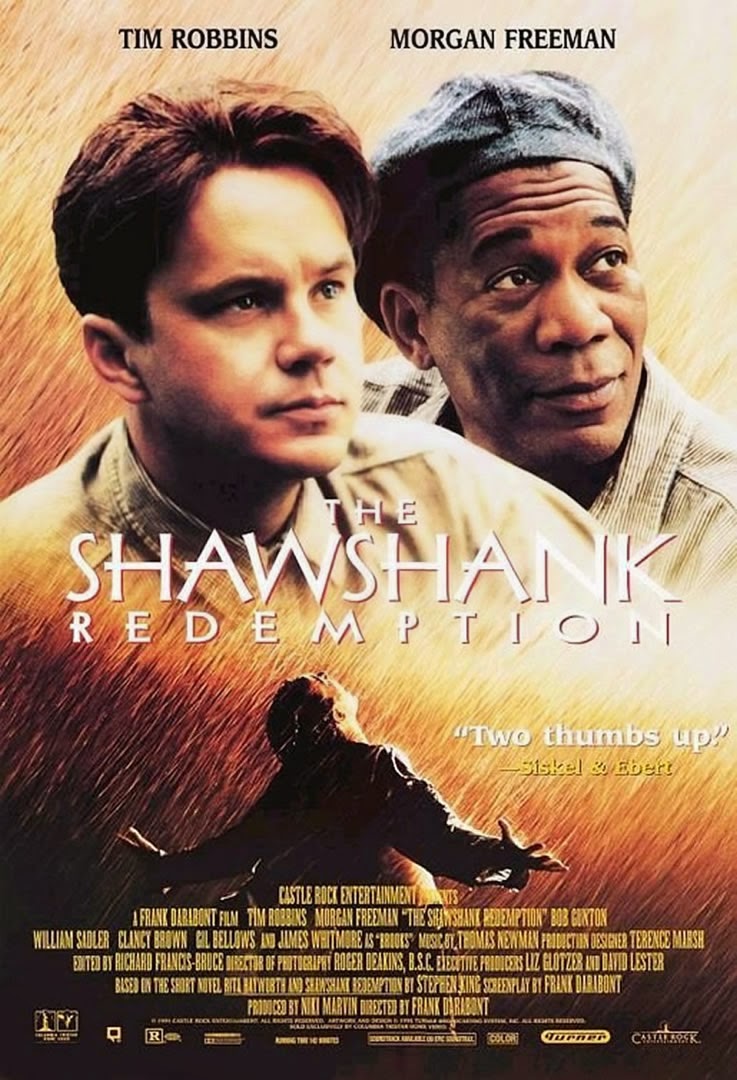
Script to Film – The Shawshank Redemption


It is undoubtedly fascinating to analyse films, but it is just as interesting to look at the screenplays that they were filmed from.  In this feature, we will be looking at how key scenes from a movie are depicted in the original script. Sometimes, the film and script are very similar, but there can also be some substantial differences, especially if the script is an early draft.

For the first “Script to Film” article, we will be looking at The Shawshank Redemption. The script for the film can be accessed below:


Who Wrote It?

The script for The Shawshank Redemption was written by Frank Darabont, who directed the film, and was based on the short story “Rita Haywoth and the Shawshank Redempton” by Stephen King.

How Long Is It?

The Shawshank Redemption is 142 minutes long, including credits.

What’s It About?

The Shawshank Redemption follows Andy Dufresne (Played by Tim Robbins), a banker who is falsely convicted for the murder of his wife and her lover, and sentenced to life without parole in Shawshank Prison.  There, he forms a friendship with fellow prisoner Red (Played by Morgan Freeman). Used as by the corrupt Warden Norton (Played by Bob Gunton) as an assistant to cover up his money laundering, Andy bides his time in prison, never losing hope in the possibility of being free.

Script to Film – The Shawshank Redemption
(The Following May Contain Spoilers)

First Night – The brutality of Shawshank Prison is highlighted in Andy’s first night there, as the long-serving inmates take bets on which of the new prisoners will break down crying. One scene that was in the script but not the film shows various new inmates terrified by their menacing surroundings. Whilst this effectively illustrates how difficult it is adjusting to life in prison, it was felt to be unnecessary. The voices of the various prisoners demonstrate the same effect as they “carry on, sly and creepy in the dark”. This creates an ominous atmosphere, and by showing the prison as a whole instead of focusing on specific inmates, makes the viewer feel like they are inside as well, which emphasises the confined the prisoners at Shawshank are.

The sadistic head guard at Shawshank, Captain Hadley, responds to the breakdown of one anxious, overweight prisoner by viciously beating him, causing his death. In the script, this act of violence is depicted in a manner that emphasises its barbarity and suggests how common it is in the prison; “All we hear now is the dull THWACK, THWACK, THWACK of the baton”. As well as showing the brutality of the act, this monotony also demonstrates detachment, as all the prisoners can do is look on in horrified silence.  The film keeps this disengagement by depicting the scene in extremely low lighting. This emphasises Hadley’s savage nature and sets up the prisoner’s lack of freedom and independence perfectly – any instinct to act against this abuse of power was quashed a long time ago.

Brooks Outside Jail – One of the saddest moments in the film centres on Brooks (Played by James Whitmore), an elderly prisoner who finally gets released after decades in prison. However, he is unable to adapt to life outside, and soon hangs himself. Brook’s disorientation in the outside world is depicted in the script through descriptions, such as a memorable one which depicts his arrival at a halfway house with the words “He just stands there, like a man waiting for a bus”. In the movie, this is shown through close-ups, as the confusion and fear on Brook’s face is expressed perfectly by Whitmore. No matter how good a scene is in the script, it requires a skilled actor to make it work. However, a strong script is essential for encouraging a great performance, and here both elements are present.

The other affecting part of the sequence is Brooks’ narration, as it becomes increasingly clear that the letter that he has just sent is a suicide note. The rapid pace of change in American society – the automobiles that Brooks considered a novelty when he was young are now everywhere – contrasts with the unfading routine of prison life, and Brooks finds himself unable to understand or comprehend it. As Brooks speaks, we find out the extent to which he is lost without the rigidity of the system  that has defined the majority of his life– he is even willing to commit a crime just so he can go back to Shawshank. In this context, the Voice-Over provides insight into Brook’s thoughts and motivations and sets up the ensuring tragedy, allowing it to be even more powerful.

Playing Beethoven – One particularly iconic scene highlights Andy’s commitment to providing hope for himself and his fellow prisoners. In it, he finds the collection of books and records donated to Shawshank by the government. He takes out a Mozart record and plays it, hijacking the prison’s sound system so he can broadcast it to all the prisoners. The power of the record is set up by Andy’s reaction to discovering it. According to the script; “It is a thing of beauty. It is the grail”. This powerful language shows that, in prison, something as mundane as a record of classical music can have a potent effect. 

The effect that the music has is highlighted through a combination of description and dialogue. We see numerous scenes of inmates throughout Shawshank stopping to listen. Throughout the prison, the monotony of daily life has been disrupted by something that is new and unfamiliar to the majority of inmates, and therefore memorable and exciting.   Red’s narration makes the significance of Andy’s rebellious gesture clear to the audience, as he states that whilst the record was on, “Every last man at Shawshank felt free”. The importance of providing hope in a place where hopelessness dominates is one of the central themes of the story, and the use of classical music is an effective way of emphasising this.

Tommy’s Death – Norton crosses the line from being merely corrupt into an outright villain when he orders the murder of Tommy, an inmate who has evidence that could prove Andy’s innocence. The impact of the scene is magnified by the lead-up to the murder, as Norton arranges a secret conversation in the prison car park.  Because we know that Norton does not want the evidence of his corruption to come to light, his show of helpfulness is unnerving, as most of his apparently sincere dialogue (“The right decision. Sometimes it’s hard to figure out what it is, understand?”)  takes on an entirely different meaning that Tommy is entirely unaware of, as he answers Norton’s questions innocently and earnestly. This Scene relies on the audience knowing that something bad will happen, but not being able to figure out exactly what until it is too late. This generates suspense and ensures that they remain interested.

The deed itself is depicted in the script in a vivid and shocking manner that contrasts with the matter-of-fact depictions of violence from earlier in the film. The gunfire is shown in graphic detail “Chew[ing]” Tommy “to pieces” until he falls to the ground in “A twitching, thrashing heap”. This brutality highlights how horrific and senseless the murder is, and reveals just how far Norton will go to prevent the truth surrounding his activities to get out. It makes us root for Andy to break free and expose him, but highlights the fact that he has to do so quickly, thus increasing the tension in preparation for the climax.

The Escape – The Shawshank Redemption’s famous climax depicts Andy’s escape from prison through a tunnel that he slowly created throughout the period he spent incarcerated. The guards’ reaction to this is one of initial confusion, which is conveyed through the sentence “Their faces go slack, stunned”. This alliteration shows the reader that the event that has just occurred is a very significant and shocking one. This bewilderment soon turns into blind panic, as they inspect everything in the room “As if Andy might be hiding in a Kleenex or a tube of toothpaste”. This shows how surprising Andy’s escape is, and leaves us wanting to know how it happened, setting up the final reveal.

Andy’s escape plan is portrayed as a twist. We are not aware of it at the time, but when we find out about it, every detail makes perfect sense. Red highlights this in his narration, likening Andy’s interest in geology to his escape, as the two things most important to both are “Pressure and time”. This reinforces the key themes without seeming too on-the-nose, and makes Andy’s escape even more satisfying.

Verdict

The Shawshank Redemption owes its status as a modern classic to a strong script brought to life by a talented cast and crew. It provides us with a number of feelgood scenes, but also contains several dark and violent ones. This balance of optimism and gritty realism ensures that the film never seems false or preachy, and the happy ending feels earned. The riveting storyline, the creative descriptions and the memorable characters ensure that the script stands out, and Frank Darabont brings it to life without reducing the quality. Therefore, both the script and the film are essential for budding screenwriters.

Friday, 29 August 2014

Unproduced Scripts - Mermaids

The unproduced script we will be reviewing this time is called Mermaids, and can be accessed below:


Who Wrote It?

Garry Hicks.

How Long is It?

The script is 106 pages long.

What’s It About?

Four friends, The unemployed Brandon, Doctor Kyle, businessman Derek and recently-fired builder Sean,  head out on a long vacation. Taking a ship belonging to Derek’s dad, they sail into the Bermuda Triangle, looking for mermaids and pirate treasure. The four are attacked by a group of sirens, led by the tyrannical Nemeritas. Sean is kidnapped by the Sirens, but the other three are rescued by a group of Mermaids, who are led by the benign Lorelei. As Brandon, Kyle and Derek seek the Mermaids’ help in finding Sean, Sean attempts to escape from the siren’s island with the help of Nemeritas’ adopted daughter Chiron.
.

5 Screenwriting Lessons – Mermaids
(The Following May Contain Spoilers)

Create a Unique Mythology – Mermaids have fascinated people for centuries, and as a result, they have been depicted in numerous works of fiction. This means that the stories featuring them have to do something unusual and interesting to stand out. In this script, the Mermaids are depicted as a benign race, whilst the Sirens are depicted as a hostile enemy. This is a clever idea, as it highlights and plays with the fact that mermaids were initially seen as predators who would lure sailors to their doom, a perception which originated from the depiction of Sirens in Ancient Greek works.  

Both sides have unique cultures and unique powers. The Mermaids have dreams that can predict the future and have the power to communicate with animals. The Sirens have shark-like teeth and the ability to control people. These quirks reflect the nature of both species perfectly – the powers of the Mermaids show that they are gentle, but also scared of their enemies and the powers of the Sirens emphasise their predatory traits. If you are depicting supernatural beings in your script, you need to adhere to the basic rules regarding the species, but apart from those, you can do anything you wish with them.

Develop the Characters – Of the various prisoners on the Siren’s Island, the one who is most developed is Joshua. His disappearance is mentioned early on in the story, he is the most experienced prisoner and he is the one who kills Nemeritas. He also has an interesting backstory, as he tells some of his fellow prisoners how difficult it is to work towards freedom without knowing if he can obtain it, and his emotional reconciliation with his daughter at the end of the film is one of its most powerful scenes.  However, he doesn't get introduced until the 76th page, which reduces his character development, and ensures that he seems like a deus ex machina who exists solely to save the day.  Characters who influence the outcome of a story should be introduced early on, especially if they have a developed personality and an interesting background, as Joshua does.

Of the four main protagonists, Brandon stands out as the leader of the group. He is the first one to be introduced, and is the most interested in the idea of mermaid mythology. Once with the Mermaids, he spends a significant amount of time interacting with them. He also builds up a romance with Lorelei’s daughter Treena. Whilst it is love at first sight for him, the growing relationship receives plenty of attention, and ends with Treena choosing to join the human world. The fact that Brandon is the member of the group with the greatest role shows that even in large groups of protagonists, there has to be a distinctive leader to help us get into the world of the script.

Ensure That the Action is Spectacular – Mermaids has two big action sequences. The first of these sees Brandon, Derek and Kyle explore the ocean on dolphins and get chased by sharks. The sharks are depicted as advancing with “Big teeth, moving fast”. This description makes the sharks menacing, as it depicts their advance in a manner that highlights its inevitability and increases the suspense of the scene as a result.

The climax, which sees the mermaids and sirens battle over Sean and Chiron’s fate, represents a far bigger and more important action scene. The big fight is depicted in short sentences loaded with commas. The style of fighting, with Mermaids launching themselves at the Sirens “Like A guided Missile” is fast-paced but coherent, with frequent pauses to show how many combatants are remaining. This makes it easy to follow, in spite of the large numbers of combatants. Therefore, it proves to be a memorable sequence, as it is simple but developed with enough detail to stand out.

Make Sure That the Scenery Stands Out – stories and films about mermaids are often defined by their vivid and evocative depiction of the ocean scenery. This script is no exception, as it features a scene where the Mermaids take Brandon, Derek and Kyle on a journey under the sea. The diversity of the underwater life is depicted in a manner that shows how amazing it already is, as the protagonists meet and interact with Sea turtles, octopuses, and “Other amazing things”. This highlights the fact that the sea is naturally beautiful and fascinating, and makes it easier to imagine what an experience it is to see up close and personal.

The script also places a good deal of emphasis on depicting the island which the Mermaids and Sirens inhabit. The mermaid’s island, Artagatis, is defined by the “lush green plants” and “hanging fruits”. Conversely, the siren’s island is shown to have “half the vegetation” and “Old, wrecked, pirate ship”. These descriptions give us an insight into the characters inhabiting the islands. The Mermaids are a peaceful species at one with nature, whilst the Sirens are destructive scavengers. Even the simplest descriptions of a place can convey the personality of those inhabiting it, and this should be emphasised when thinking about how to depict a location.

Have a Firm Grasp on Tone – One of the major flaws with this script is its tonal inconsistency. In many ways, it resembles a story aimed at children. The heroes are purely good, and the villains are purely bad. The most complex character is Chiron, who is torn between obeying Nemeritas and her growing feelings for Sean. However, the third act revelation that she is in fact Lorelei’s missing daughter makes the story seem a bit too simplistic, as it highlights the fact that everyone on both sides is depicted in a simple and unambiguous light.

The story also has a rather immature sense of humour. There are several references to flatulence and other pieces of toilet humour that are more likely to appeal to children than adults. This would be less of a problem if the characters were younger, but they are all adult males in their thirties. This makes them seem a bit juvenile and therefore less likeable. Furthermore, one of the main themes is the prospect of mating, as the Sirens kidnap Sean so that he can impregnate Chiron, and the mermaids want Kyle, Derek and Brandon to generate children for them. This is hardly an appealing subject for children. However, the majority of the script seems to be focused on a family audience. There is little violence, and the language is not as crude as you would expect from the four protagonists. This ensures that the project is stuck between a rock and a hard place, as it is neither edgy enough to attract a teenage or adult male audience, nor is it entirely suitable for young children.

Verdict

Overall, Mermaids is not a particularly strong script. It has a good storyline and succeeds in depicting the oceans and islands on which the story is set in a vivid manner. However, it has a number of weaknesses. With the exception of Joshua and Chiron, none of the characters are particularly interesting, and the script isn't funny enough and is low on action, although the few action sequences are described well. Furthermore, it can’t decide whether to aim for children or adults, and would have been better if it had gone for a single audience. Whilst its depictions of mermaids are imaginative and the scenery is colourful, it is often derivative and weak. With a bit more effort invested, it could have been a highly enjoyable family film or raunchy adult comedy, but it ultimately turns out to be a sophomoric disappointment.